
Guide · WordPress · WooCommerce · Make.com

Make.com WordPress and WooCommerce integration: connect, draft posts and route orders

Short answer: to connect WordPress to Make, install the free Make Connector plugin, copy the API key from the new Make menu in WordPress, and paste it into Make with your site's REST API address (https://your-site.com/wp-json/). WooCommerce uses its own keys instead: a Consumer Key and Consumer Secret from WooCommerce › Settings › Advanced › REST API. Three flows cover most needs:

  • Draft: turn rows in a Google Sheets content calendar into WordPress drafts, with an optional AI first draft.
  • Sell: send each new WooCommerce order to Google Sheets and Slack the moment it arrives.
  • Announce: post each newly published article to Slack or a log sheet.

Most failed connections come down to three things: permalinks set to Plain, a cache in front of /wp-json/, or a free WordPress.com site, which can't install plugins.

By Flowpaja · Published · Facts checked

This guide contains an affiliate link, marked “affiliate link”.

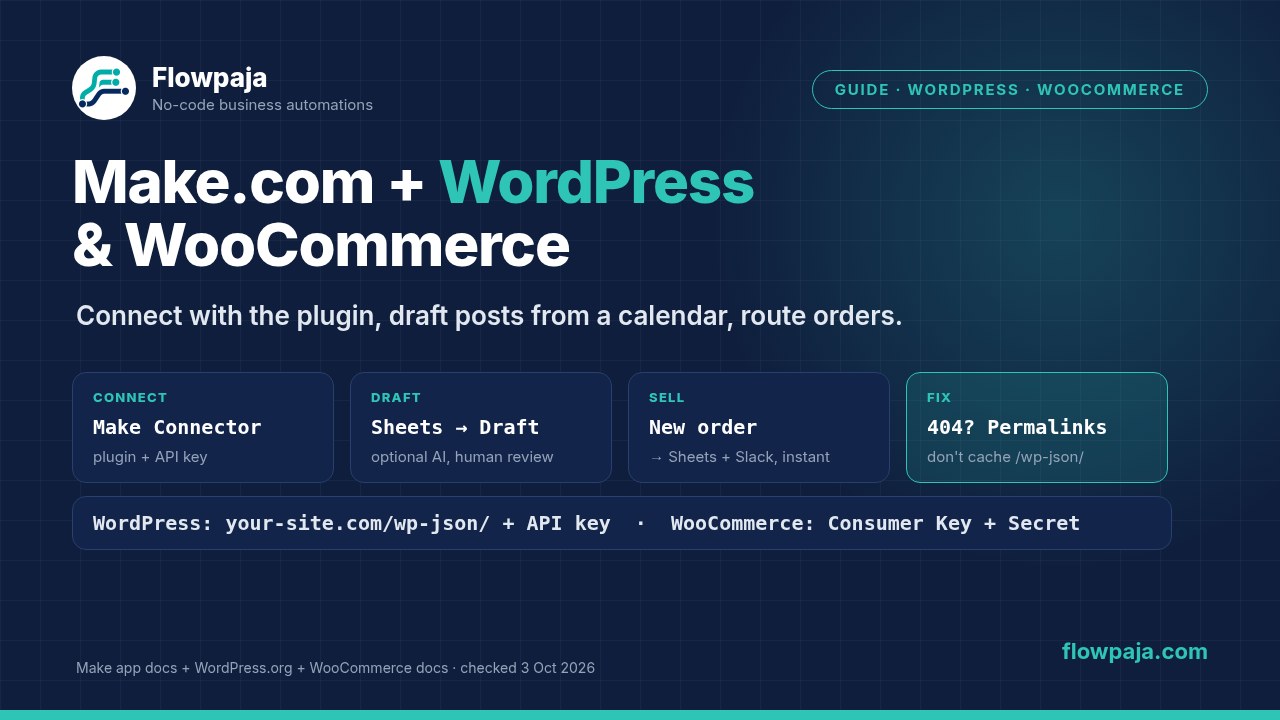
Make.com WordPress and WooCommerce integration: the Make Connector plugin and API key connect WordPress, a Google Sheets calendar creates draft posts, and new WooCommerce orders go to Google Sheets and Slack
Connect with the Make Connector plugin, create drafts from a calendar, and route WooCommerce orders.
Checked on 3 October 2026: setup steps and module names come from Make's WordPress and WooCommerce app docs (apps.make.com, both updated 2 October 2026) and Make's integration pages. Plugin details come from the Make Connector page on WordPress.org. WooCommerce key steps come from WooCommerce's REST API documentation. Plan limits come from Make's pricing page, as seen from a US connection. We haven't published a WordPress template, so the module and credit counts below are derived from Make's credit rule, not measured. Check the real numbers in your scenario's History. We earn affiliate commissions from Make.

What you need

  • A Make account. All three flows work on the Free plan (see Plan check). If you don't have an account yet, create a free Make account (affiliate link).
  • A WordPress site where you can install plugins, as an administrator. On WordPress.com, plugins can be installed on the paid plans (Personal, Premium, Business and Commerce), not on free sites.
  • A site Make can reach from the internet. A copy on your own computer (localhost) or a staging site behind a password won't work.
  • For WooCommerce: SSL (an https:// address) and permalinks set to anything other than Plain. Make's docs say "you need to enable SSL on your WordPress web page and use pretty permalinks", and WooCommerce's own docs ask for any permalink option other than Plain.

Affiliate disclosure: the link marked "affiliate link" includes our partner code. If you sign up or later buy a paid plan through it, Flowpaja may earn a commission at no extra cost to you. More on the tools we use: best tools for Make automation.

Connect WordPress to Make

  1. Install the plugin. In WordPress, go to Plugins › Add Plugins, find Make Connector, click Install now, then Activate Plugin. A new item called Make appears in the admin menu on the left.
  2. Copy the API key. Click Make in the sidebar and, on the General Settings tab, click Reveal next to the API key. Treat it like a password.
  3. Create the connection in Make. Add any WordPress module, for example Create a Post, and click Create a connection. Enter the WordPress REST API base url, which is your address plus /wp-json/, paste the key into the API Key field, and click Save.
  4. Test it. Run the module once. If it fails, open https://your-site.com/wp-json/wp/v2/ in a browser. If that page is a 404, see the problems table.

Good to know about the plugin:

  • Old name. On WordPress.org the plugin is called Make Connector, but its address and folder still use integromat-connector, from before Integromat became Make. Searching for "Integromat Connector" finds the same plugin.
  • Plugin facts. Version 1.6.6, last updated 9 February 2026, 70,000+ active installs, WordPress 5.0 or higher, PHP 7.2 or higher, tested up to WordPress 6.9.9. The plugin page says it "does not send any data to the make.com service itself"; it simplifies the connection and can add custom fields to REST API responses.
  • Custom fields. To read or write custom fields (post meta), tick them under Make › Custom API Fields and click Save Settings. Otherwise they don't appear in Make.
  • Security settings. On the General Settings tab you can click Regenerate for a new API key and enable granular API permissions, which tie the key to specific actions. Under Make › Security you can turn on Security Logging, Content Sanitization, Rate Limiting (a maximum number of API requests per minute), Request Size Limits and File Upload Security. If you regenerate the key, update the connection in Make too. If you turn on rate limiting, leave enough room for your scenarios.
  • Large sites. Make's docs say the plugin "is not optimized to run with large websites". If you see a memory size exhausted error, they recommend raising the PHP memory limit beyond the default 512 MB (your host can help).
  • Older scenarios may use the WordPress (legacy) app, which connected through a different plugin (JSON Basic Auth). For new work, use the current WordPress app and the Make Connector.

What Make's WordPress and WooCommerce apps can do

AppTriggersActions and searches
WordPress (39 modules)Watch Posts · Watch Posts Updated · Watch Categories · Watch Comments · Watch Media Items · Watch Tags · Watch Users. All are scheduled, not instant.Create, Update, Delete, Get and Search modules for posts, categories, comments, media items, users and tags · Search Taxonomies · Make an API Call
WooCommerce (56 modules)New Event (instant: an order, customer, coupon or product is created, updated or deleted) · Watch Orders, Watch Products, Watch Customers, Watch Coupons (scheduled)Search for an Order, Get, Create, Update and Delete an order · Update an Order Status · order notes · customers and coupons · products, including batch changes, variations, attributes, terms and categories · Make an API Call

Module lists: Make's WordPress and WooCommerce app docs and integration pages, checked 3 October 2026. Make's integration pages mark only WooCommerce's New Event as instant.

The difference matters for credits. A scheduled trigger costs 1 credit for every check, even when nothing is new. Checking every 15 minutes is 96 checks a day, about 2,900 credits a month, which is more than the Free plan's 1,000. An instant trigger only costs credits when something actually happens.

Recipe 1: Google Sheets content calendar to WordPress drafts

Plan posts in a sheet with the columns Title, Brief, Category, Status, Post ID and Link. When a row is marked Ready, Make creates a WordPress draft and writes the post ID back.

  1. Schedule: once a day is enough for a content calendar.
  2. Google Sheets › Search Rows: filter on Status = Ready. Each matching row becomes its own bundle, so the next modules run once per row. If nothing comes back, see Search Rows returns nothing.
  3. Optional AI draft: for example, Google Gemini AI › Simple Text Prompt. It needs no API key and is billed in Make credits. Ask for a body in HTML from the brief. Claude and Gemini in Make and ChatGPT and OpenAI in Make compare the options.
  4. WordPress › Create a Post: map the title, the content and the category. Set the status to Draft, or Pending review. The WordPress REST API accepts draft, pending, future, publish and private; check how your module labels them.
  5. Google Sheets › Update a Row: set Status to Draft created and save the post ID and link from Create a Post's output. Check the output field names in a test run. This step also stops the same row from creating a second draft tomorrow.
  6. Optional: Slack › Send a Message to tell the editor a draft is waiting.

Derived credits: 1 for the search on each run, then 2 per post (Create a Post and Update a Row), plus 1 for the Slack message and whatever the AI module uses. Ten posts a month on a daily schedule comes to about 30 + (10 × 3) = 60 credits before AI (50 without the Slack message).

Featured images: upload the image first with WordPress › Create a Media Item, then map the media ID into the post's featured image field. Check the field name in your module. Make's max file size applies, which is 5 MB on the Free plan.

Keep a person in the loop. Make can publish straight away, but we don't recommend it for AI text. AI gets facts, prices and names wrong. Google's spam policies also give "Using generative AI tools or other similar tools to generate many pages without adding value for users" as an example of scaled content abuse. Use the automation to save the copying and formatting, then have someone edit and publish each draft.

Recipe 2: New WooCommerce orders to Google Sheets and Slack

First, create the WooCommerce keys. In WordPress, go to WooCommerce › Settings › Advanced › REST API and click Add Key (or Create an API key). Enter a description, choose the user, set Permissions to Read/Write, as Make's WooCommerce docs say (a Read-only key can only fetch data, and the New Event trigger has to create a webhook in your shop), and click Generate API Key. Copy the Consumer Key and Consumer Secret right away: WooCommerce shows the secret only once. In Make, the WooCommerce connection asks for the Consumer Key, the Consumer Secret and your shop's https:// address.

  1. WooCommerce › New Event (instant). Click Create a webhook, then create the connection. The trigger fires when an order, customer, coupon or product is created, updated or deleted.
  2. Filter so only new orders continue. If you can choose a single event when you create the webhook, choose the one for new orders. Otherwise, filter on the event type in the output, which you'll see after a test order.
  3. Google Sheets › Add a Row: order number, date, customer, email, total and status.
  4. Slack › Send a Message: for example, "New order #1234, 89.00 EUR, Jane Doe", with a link to the order in WordPress admin.

Derived credits: 3 per new order (trigger, Add a Row, Send a Message); filters are free. Events that the filter stops still cost 1 credit for the trigger, so if every order update also fires the webhook, expect more than 3 credits per order in total. Check your History after a few days.

Prefer polling? Watch Orders works without a webhook but checks on a schedule, so it costs credits even on days with no orders (see the credit note above). For a shop with a few orders a day, New Event is usually cheaper.

Line items arrive as an array: one order can hold several products. To write one row per product, add an Iterator. Iterator vs Aggregator explains how. Our Shopify orders to Google Sheets recipe uses the same pattern for Shopify.

Changing order statuses from Make: Make's Update an Order Status module says it needs the Order Status Manager plugin. Without it, use Update an Order and test on a dummy order first.

Recipe 3: Announce new posts

WordPress › Watch Posts, then Slack › Send a Message with the title and link, or Google Sheets › Add a Row for a content log. Watch Posts is scheduled, so run it once or twice a day rather than every 15 minutes. That's about 30 to 60 credits a month for the checks, plus 1 per new post. When you first set it up, choose to start from now, so old posts aren't all announced at once. Check in a test run that it picks up only published posts, not drafts.

For social posts instead of Slack, see Instagram and Facebook automation with Make. If you also publish videos, YouTube automation with Make covers the YouTube side.

Common WordPress and WooCommerce problems in Make

SymptomLikely causeFix
404 when creating the connectionPermalinks set to Plain, so /wp-json/ doesn't existSettings › Permalinks › Post name (or anything except Plain), then open https://your-site.com/wp-json/wp/v2/ to check
Watch Posts or Search Posts misses new posts; Create a Post returns empty output or no post IDA CDN, host cache or caching plugin is caching /wp-json/In the CDN, the host cache and any caching plugin, add a do-not-cache rule for paths starting with /wp-json/, then clear the caches (Make's docs give this fix)
"The WordPress REST API did not return a post ID"Same caching problemSame fix, then check in WordPress whether the post was created before you run it again
memory size exhaustedThe plugin ran out of PHP memory on a large siteRaise the PHP memory limit beyond 512 MB
Connection worked, then stoppedThe API key was regenerated, or the plugin's permissions or rate limit block the requestPaste the new key into the Make connection; check Make › General Settings and Make › Security
Access denied although the key is rightA security plugin, firewall or host rule blocks the REST APIAllow REST API requests from Make. WordPress's own REST API FAQ advises against disabling the REST API
HTML, embeds or attributes missing from created postsContent Sanitization in Make › Security "removes potentially harmful HTML tags and attributes from incoming content"Check whether it's on and test with your real content; keep it on unless you trust every source
Custom fields missing in MakeThey aren't exposed to the REST APITick them under Make › Custom API Fields and save
WooCommerce connection failsNo SSL, Plain permalinks, a wrong address or wrong keysUse the https:// address, change permalinks, generate a new key pair
WooCommerce write action refusedThe key only has Read permissionGenerate a key with Read/Write
Can't install the plugin on WordPress.comFree WordPress.com sites can't install pluginsUpgrade to a paid WordPress.com plan
Duplicate draftsThe row's status wasn't updated, or the scenario ran twiceUpdate the row right after Create a Post and keep the Status filter in Search Rows

Rows 1 to 5 and the custom-field row come from Make's WordPress app docs (troubleshooting and plugin settings). The sanitization row is our reading of the Content Sanitization setting. The WooCommerce rows come from Make's WooCommerce docs and WooCommerce's REST API documentation. The security-plugin row is our hedge; we haven't tested specific plugins.

More error messages and their fixes: Make error cheat sheet. For webhook triggers that never fire, see webhook not receiving data. If a scenario turned itself off after errors, see scenario stopped or disabled.

When there's no module: Make an API Call

Both apps have a Make an API Call module that uses the same connection, for any REST endpoint your key may use. Examples are a custom post type, or a WooCommerce endpoint without its own module. Usually you enter only the endpoint path, such as wp/v2/pages for pages, because the connection already holds your site address. Check the module's help text for the exact format it expects. To shape request bodies, see our webhook JSON guide.

Plan check

  • Free plan: the WordPress, WooCommerce, Google Sheets and Slack apps, all three recipes, and AI drafts with the Gemini Simple Text Prompt. The limits are 1,000 credits a month, checks no more often than every 15 minutes, 2 active scenarios, and a 5 MB max file size, which matters for images.
  • Paid plans: more credits, a 1-minute minimum interval, a higher max file size (100 MB on Core, 250 MB on Pro, 500 MB on Teams and 1,000 MB on Enterprise) and runs of up to 40 minutes.
  • Not needed: the Make Code app (not on Free) or custom functions (Enterprise).
  • On the WordPress side: the Make Connector plugin is free. WordPress.com sites need a paid plan to install it.

Make pricing page, as seen from a US connection, 3 October 2026. Plans change; check the current page before you buy.

Sources checked (3 October 2026)

  • Make: WordPress app docs (plugin install, API key, connection fields, custom fields, security settings, memory note, troubleshooting, module list); WordPress (legacy) app docs; WooCommerce app docs (SSL and permalink requirement, keys, New Event, module list); WordPress and WooCommerce integration pages (module counts, instant vs scheduled, Order Status Manager note)
  • Make pricing page: credit rule, credits per plan, max file size, run time, minimum interval, active scenarios, as seen from a US connection
  • WordPress.org: Make Connector plugin page (version 1.6.6, last updated 9 Feb 2026, requirements, changelog); REST API handbook: Posts reference (status values) and FAQ (updated 16 Jan 2024)
  • WooCommerce: REST API documentation (permalinks, generating keys, permissions, secret shown once)
  • WordPress.com Support: Install a plugin (paid plans only)
  • Google Search Central: spam policies (scaled content abuse; updated 28 Aug 2026) and guidance on using generative AI content (updated 1 Oct 2026)

FAQ

Do I need a plugin to connect WordPress to Make?
Yes. Make's current WordPress app needs the free Make Connector plugin from WordPress.org. Its address still says integromat-connector, its name from before Integromat became Make. After you activate it, click Make in the WordPress sidebar, then Reveal next to the API key on the General Settings tab, and paste it into the Make connection together with https://your-site.com/wp-json/.
Where do I find the Make API key in WordPress?
In the WordPress admin sidebar, click Make. On the General Settings tab, click Reveal next to the API key. You can click Regenerate there for a new key. If you do, update the connection in Make.
Why does Make show a 404 error for my WordPress REST API URL?
Usually because Settings › Permalinks is set to Plain. Make's docs say this can disable the REST API. Choose Post name or any other option, open https://your-site.com/wp-json/wp/v2/ to confirm it works, then enter https://your-site.com/wp-json/ in Make.
Why does Create a Post return no post ID?
Make's docs point to caching: a CDN, your hosting provider or a caching plugin stores copies of the /wp-json/ responses. Add a do-not-cache rule for paths starting with /wp-json/ in each of them, clear the caches, and check in WordPress whether the post was created before you run the scenario again.
Is the WooCommerce trigger in Make instant?
New Event is instant. It fires when an order, customer, coupon or product is created, updated or deleted, and needs a webhook created in Make. Watch Orders, Watch Products, Watch Customers and Watch Coupons are scheduled, so they cost a credit on every check.
Does Make work with WordPress.com?
Yes, if the site can install plugins. WordPress.com allows plugins on its paid plans (Personal, Premium, Business and Commerce), not on free sites.
Should Make publish AI-written posts automatically?
We recommend creating drafts and having a person edit and publish them. AI gets facts wrong. Google's spam policies also list using generative AI to generate many pages without adding value as scaled content abuse.

WordPress or WooCommerce scenario not doing what it should?

Send us the scenario blueprint and a screenshot of the error or the History. We'll find why the connection fails, posts come out empty or orders go missing, and fix it. It's fully async: no logins and no calls.

Automating the rest of the business too? The Make Starter Bundle has three ready-made templates: a lead router to HubSpot and Slack, Gmail invoice reminders, and quote follow-ups.

← All guides · All templates

Make, WordPress, WooCommerce, WordPress.com, Google, Google Sheets, Gemini, Slack, Shopify and OpenAI are trademarks of their owners. Flowpaja is independent and not affiliated with or endorsed by them. Limits, plans and prices change; check Make's current pricing page and Help Center.